
Research

Ten years after the Brexit referendum: Introduction - The European question, ten years on
22 June 2026
Anton Spisak on the decade that has reshaped Britain but left its place in Europe unsettled

Ten years after the Brexit referendum: The steps forward
22 June 2026
Daniela Schwarzer on the practical agenda that could make the UK and the EU stronger together.

Ten years after the Brexit referendum: Beyond the reset
22 June 2026
Charles Grant on how much closer UK-EU relations can go – and what could make a more ambitious partnership possible.

Ten years after the Brexit referendum: The past, present and future of the UK's relationship with the EU
22 June 2026
This collection of short essays asks what leaving the EU means a decade after the divisive referendum, for Britain, for the EU and for the relationship between them.

Ten years after the Brexit referendum: The costs of separation
22 June 2026
John Springford and Anton Spisak on how much Brexit has cost the UK economy – and why the hardest trade-offs still lie ahead.

Ten years after the Brexit referendum: The long shadow of Brexit
22 June 2026
David Lidington on how leaving the EU absorbed a decade of British politics without addressing the grievances behind it.

Ten years after the Brexit referendum: A more fragile union
22 June 2026
Philip Rycroft on how Brexit strained the UK union while making its break-up harder.

Ten years after the Brexit referendum: The ghost in the statute book
22 June 2026
Catherine Barnard on why leaving the EU has not freed Britain from the gravitational pull of EU law.

Ten years after the Brexit referendum: Britain and the EU in a world of disorder
22 June 2026
David Miliband on why Britain and the EU need a stronger partnership in a more dangerous world.

Ten years after the Brexit referendum: One crisis among many
22 June 2026
Nicolai von Ondarza on how the EU has adapted to a decade of crises – and how Brexit has left its mark on European politics.

Ten years after the Brexit referendum: A gap in Europe's defences
22 June 2026
Julian King on why closing gaps in UK-EU security co-operation is a strategic necessity.
The cost of Brexit, ten years on: The impact of leaving the customs union and single market on UK trade
18 June 2026
New CER modelling exercise shows that Brexit has substantially reduced the UK’s trade with the EU.

Rearming Europe for deterrence: Short-term priorities and policy options
09 June 2026
There are key steps European governments can take in the next 1-2 years to accelerate rearmament, readiness and deterrence efforts.
Europe has produced tech champions: Here is what they can teach us
27 May 2026
Despite the gloom about its place in the digital economy, Europe has produced tech leaders.
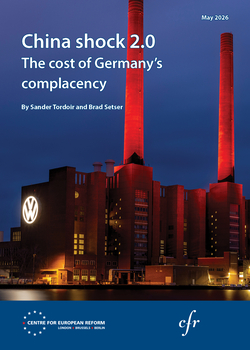
China shock 2.0: The cost of Germany's complacency
20 May 2026
Germany is ground zero of the second China shock, but Berlin is not fighting back, even as the shock erodes the country’s engineering sectors that are vital to its economic security.

The EU is trying to speak the language of power in Africa, but what is it saying?
01 May 2026
Africa is currently the continent with the largest number of armed conflicts in the world – over 50 – representing 40 per cent of all wars globally. This is a 45 per cent increase since 2020.

What Orbán’s departure means for Hungary and for Europe
14 April 2026
Hungary’s voters have ended Viktor Orbán’s 16-year rule. Tisza’s win is a unique chance to restore democracy – and a time-limited opportunity for the EU to emerge stronger.
Energy shock 2.0: Lessons from 2022 for the Hormuz crisis
13 April 2026
If the Strait of Hormuz stays closed, Europe will face as serious an energy crisis as it did in 2022. This time, energy poverty policies must be more targeted, and electrification more ambitious.

One year liberation day: The delusion of transatlantic economic divorce
07 April 2026
A year after Liberation Day, Washington and Brussels are still fighting each other – not China.

WTO reform after Yaoundé: What next for the multilateral trade order?
02 April 2026
The failure of the WTO’s ‘reform ministerial’ deepens the strain on the global trade system. But it also points to a possible path for future co-operation among coalitions of the willing.